
Image Description: The image is a simple black graphic on a white-transparent background. At the top, there is a trail of solid circles arranged in a loose spiral shape, representing the movement of the sign-word for SIGN-LANGUAGE. At the bottom, there are many small solid squares forming two overlapping diagonal lines, symboling the sign-word for “city”.
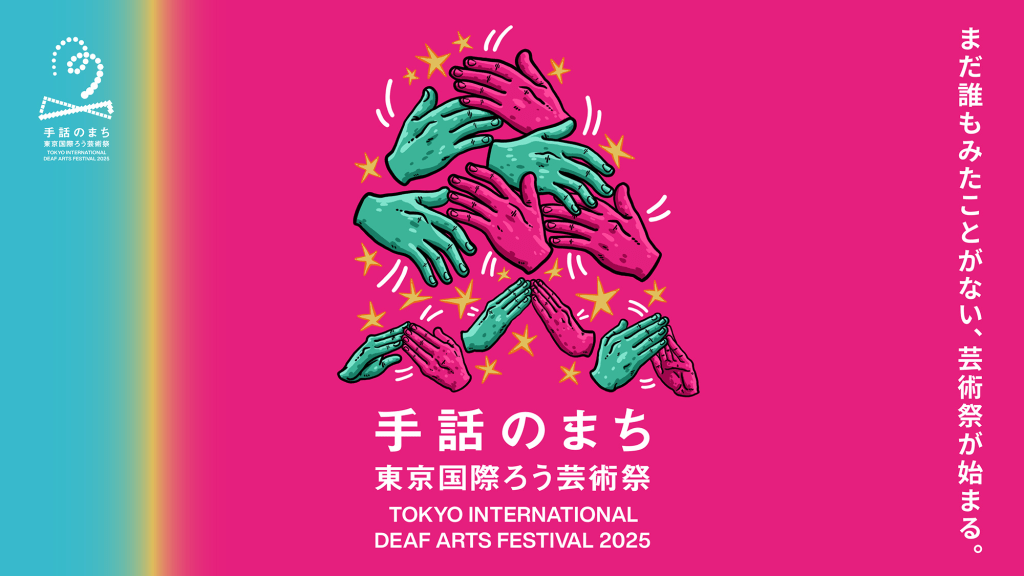
Image Description: The image is a colourful promotional visual for the Tokyo International Deaf Arts Festival 2025. The background is a strong magenta pink. In the centre, there is a cluster of illustrated hands in motion, drawn in vibrant pink and turquoise. The hands overlaps and face different directions, with small white motion lines and yellow stars around them.
In November 2025, I stepped into Koenji, Tokyo, Japan, for the very first Tokyo International Deaf Arts Festival (TIDAF), held under the beautiful theme “City of Sign Language”. Organised by the Deaf Arts Society of Japan (DAS), the festival ran from 6 to 9 November 2025 at ZA-KOENJI in Suginami as a new Deaf-led arts festival focused on Deaf culture and sign languages.
Previously known as the Tokyo International Deaf Film Festival in Shibuya, this new incarnation expanded beyond film into theatre, immersive performance, exhibitions, workshops, and more, all centred on Deaf experiences (often described as Deafhood) and sign languages from Japan and around the world. For four days, Koenji felt like it had transformed into a living signing town.
Everywhere I looked, there were conversations in sign languages, Deaf artists, banners and pop-up events. I arrived excited and a bit overwhelmed. I left with my head and heart full, inspired by the power of Deaf-led arts when an entire festival is designed around our languages and our visual ways of seeing.
Learning through Visual Language: Workshops with Eddy and Douglas
One of the most nourishing parts of my time at TIDAF was being a learner again in two very different but connected workshops.
Visual Vernacular (VV) Workshop with Eddy (Mexico)
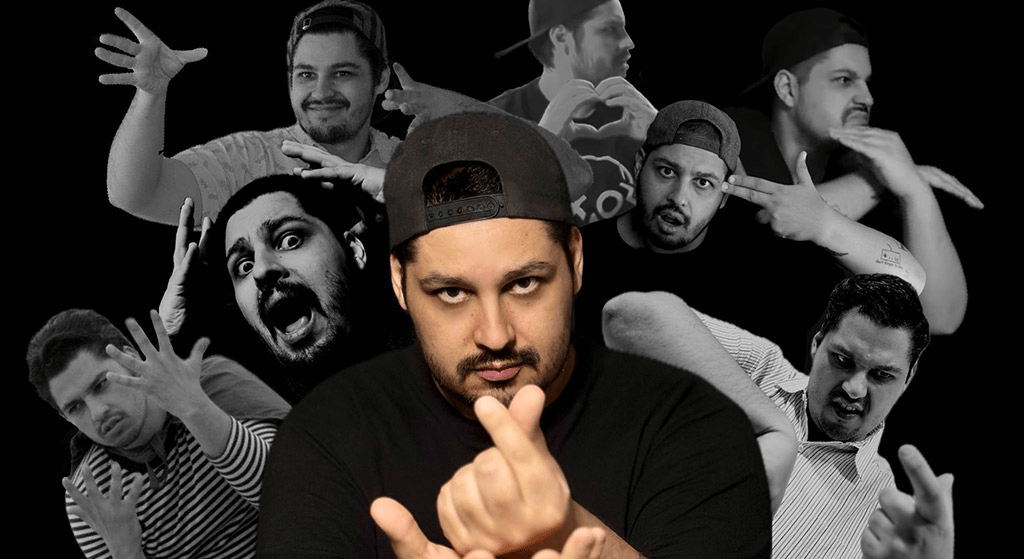
Image Description: The image is a dramatic collage of the same man in multiple poses against a black background. In the centre foreground, he is in colour, wearing a black T-shirt and a backwards cap. He looks straight at the camera, holding his hands out in front of him.
I participated in the VV workshop with Eddy, a Deaf artist-performer from Mexico. VV is described as an internationally recognized performance art for visual storytelling, created and developed by Deaf people.
In the workshop, Eddy introduced the fundamentals of VV: how to shape clear visual images, use body shifts and rhythm, and move smoothly between different “camera angles” in the mind’s eye. The session was designed to be accessible even for beginners, and it really showed how VV can cut across different sign languages, and create connection through shared visual storytelling.
Since I first explored the VV in 2020, I have been glad to learn more from different Deaf artist-performers from China, France and the USA. With this knowledge, I hope to keep challenging myself and growing in this art form.
Visual Sign Language Expression with Douglas Ridloff (New York, USA)
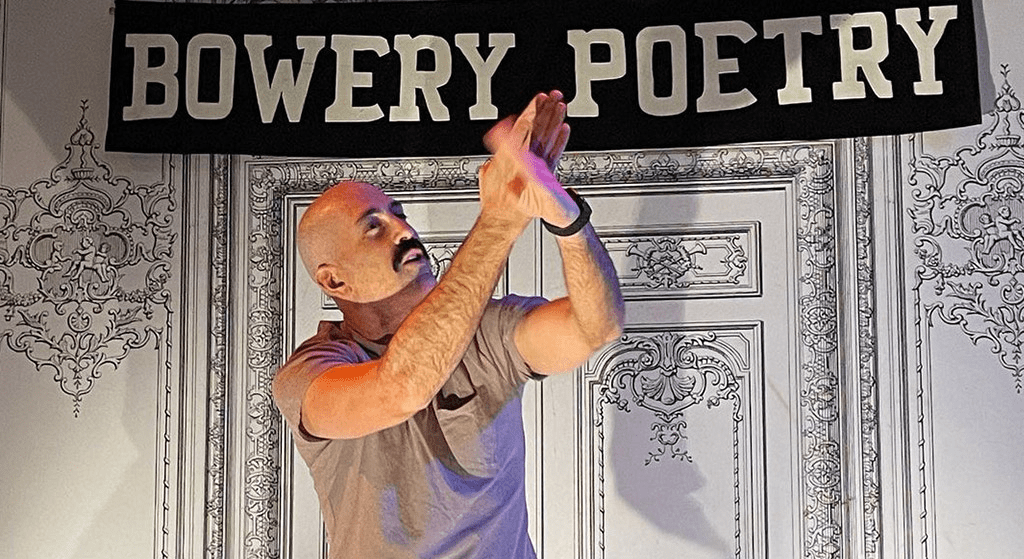
Image Description: A bald performer with a moustache stands on stage before an ornate backdrop and a banner reading “BOWERY POETRY”. Under warm stage lighting, he raises his arms and shapes his hands like a bird flapping its wings, creating an intimate, expressive moment.
I also attended “Visual Sign Language Expression”, a workshop led by Douglas Ridloff, founder and host of ASL SLAM/SIGN SLAM. The workshop focused on visual sign language artistry: exploring playful handshapes, experimenting with timing and framing, and building short pieces that are poetic in different sign languages.
The session welcomed participants at different levels, from those trying this kind of creative signing for the first time to more experienced signers developing their own visual style.
As a Deaf arts & music artist-practitioner, I loved the balance between creative freedom and steady rhythm. It reminded me that our sign languages are not only languages for communication, they are also rich artistic materials for performance, rhythm and choreographed storytelling.
Theatre Shows that stayed with me: Mark of a Woman, On the Edge, Legend & A Hundred Years of Sleep
I was also able to watch several theatre works that each of which opened up a different world for me.
Mark of a Woman
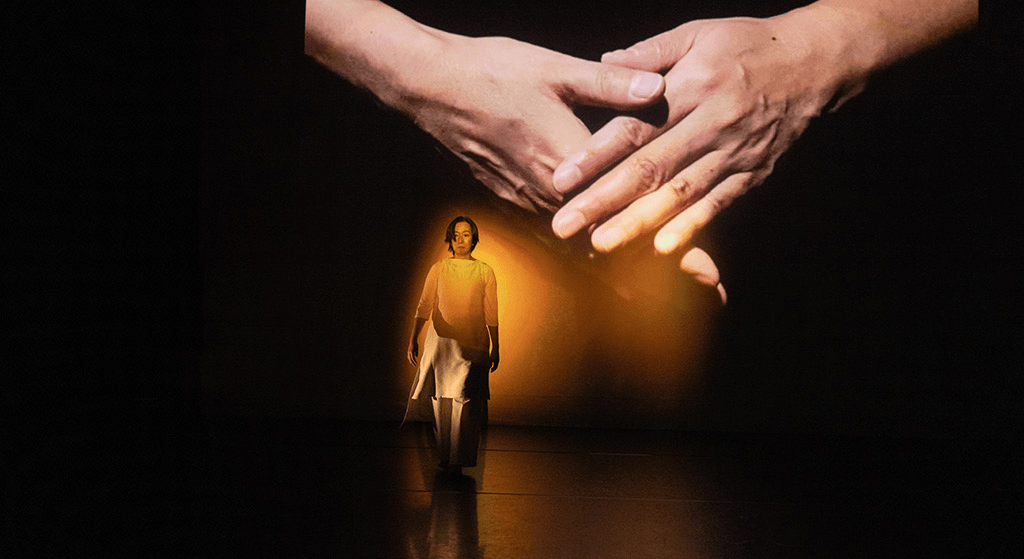
Image Description: A performer in loose white clothing stands in a warm yellow spotlight on a dark stage, while a huge close-up of two gently interlaced hands is projected above them. The contrast between the intimate hands and the solitary figure creates a quiet, poetic sense of touch and connection.
“Mark of A Woman” by Chisato Minamimura is a performance project celebrating personal histories and lesser told stories about women and tattoo culture. The piece uses Visual Vernacular, digital animation, kinetic projection and Woojer technology to explore how women relate to decorating their bodies.
I learnt that this work is a monologue performed by Chisato herself, and I really like this concept blending a solo story with digital technology. It has inspired me to develop my own piece, and I hope to present it later this year.
On the Edge by Teater5005
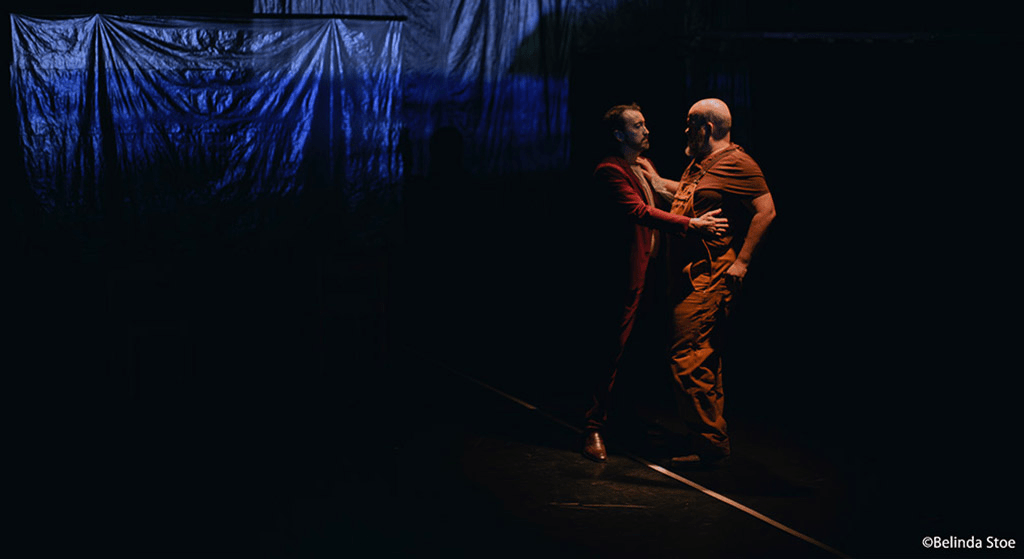
Image Description: Two performers stand in a narrow spotlight on a dark stage, facing each other closely as if in a tense confrontation. One wears a red suit, the other brown work clothes. Behind them, a large draped fabric glows faintly blue in the darkness.
“On the Edge” by a Danish company Teater5005 follows Niels, a perfectionist working a theatre whose mental health deteriorates as strange events on stage disturb his sense of reality. The piece dives into his psyche, mental health and the oddness of human interactions.
Legend
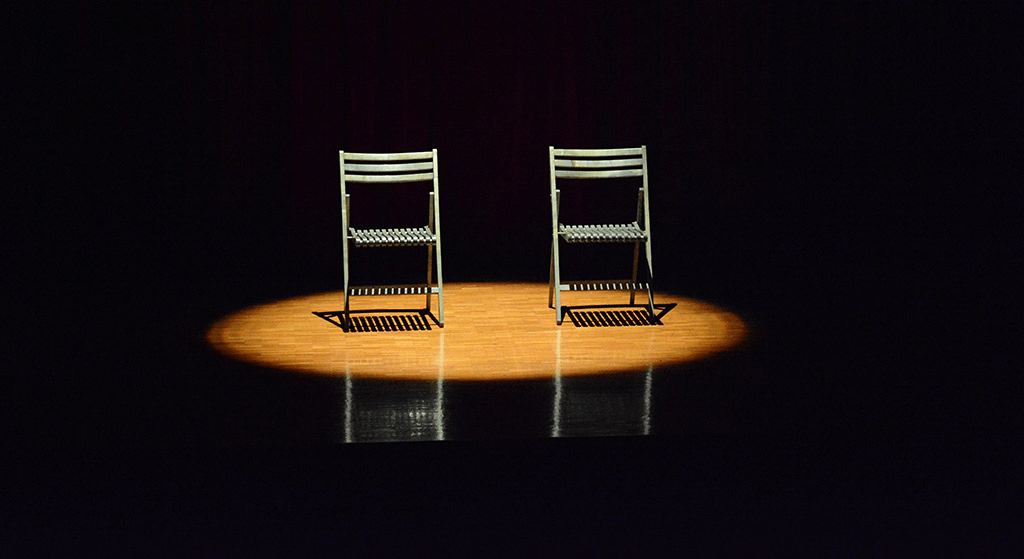
Image Description: Two empty metal chairs sit side by side on a wooden stage, isolated in a single round spotlight against a dark background.
I also watched “Legend”, one of the main theatre programmes at the festival. Dedicated to many Deaf people, it is described as a timeless masterpiece that traces the history of the Deaf, now brought to audiences in Japan.
A Hundred Years of Sleep

Image Description: A close-up of a young girl’s face fills the left side of the image, sharply focused on her eye, while in the blurred blue background several people in colourful clothes stand or sit out of focus.
“A Hundred Years of Sleep” began in 2018 as a long-term project with actors from the Japanese Theatre of the Deaf and Deaf puppet Theatre Hitomic, directed by Shuji Onodera of Company DERASHINERA. It explores and crosses boundaries between dance, mime, sign language, and spoken words. The piece draws inspiration from Grimm’s fairy tale, “Sleeping Beauty”, and at TIDAF it was performed multiple times across two days.
The shows I watched confirmed something important for me: Deaf theatre does not need to imitate hearing models in theatre. It can build original aesthetics from our visual strengths, our sign languages, and our lived experiences.
Immersive Theatre “Intersection”: a shiok Journey through Time
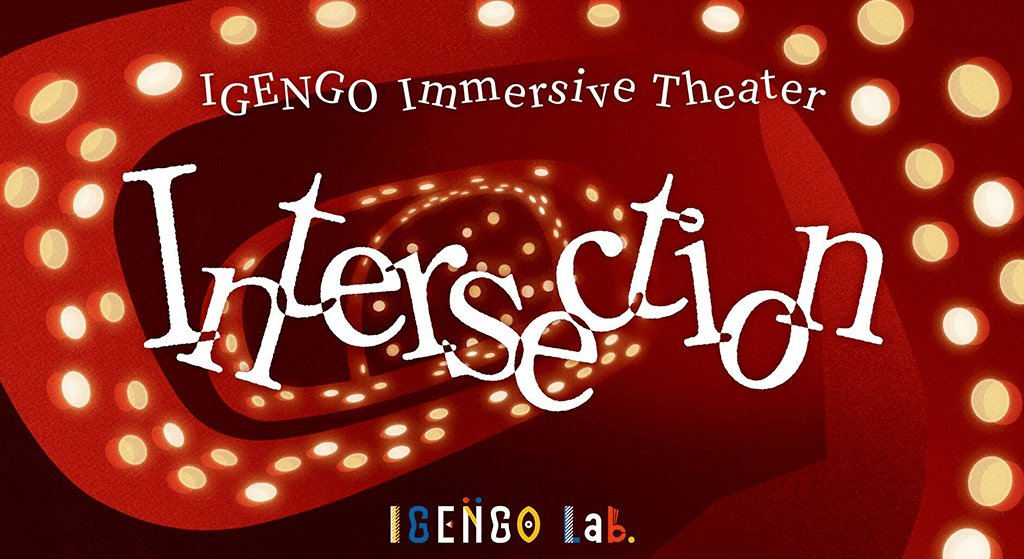
Image Description: A bright red poster shows a glowing tunnel of circular lights with the large, playful word “Intersection” across the centre and “IGENGO Immersive Theater” above it, with the IGENGO Lab. logo at the bottom.
One of my favourite experiences at TIDAF was “Intersection”, an immersive theatre piece by IGENGO Lab. The audience become space-time detectives travelling through E-Gen City, a lively place where sign languages and spoken languages coexist, to prevent the murder of the mayor by travelling back into the past.
As we moved through the story, we witnessed different characters’ destinies intersecting and shifting between “being understood” and “not being understood”. The performance brought Japanese Sign Language (JSL), International Sign (IS), Japanese Language and English Language together in a single world, described as an “unprecedented communicative immersive theatre experience”.
Being inside “Intersection” was really shiok. I was not just watching from a distance; I was navigating the story physically, responding, reading clues and feeling the tension of changing the future. It felt like a live example of translanguaging in Deaf space: people switching naturally between JSL, IS, and other resources to solve a shared problem.
Stepping into the ring: SIGN SLAM Qualifiers
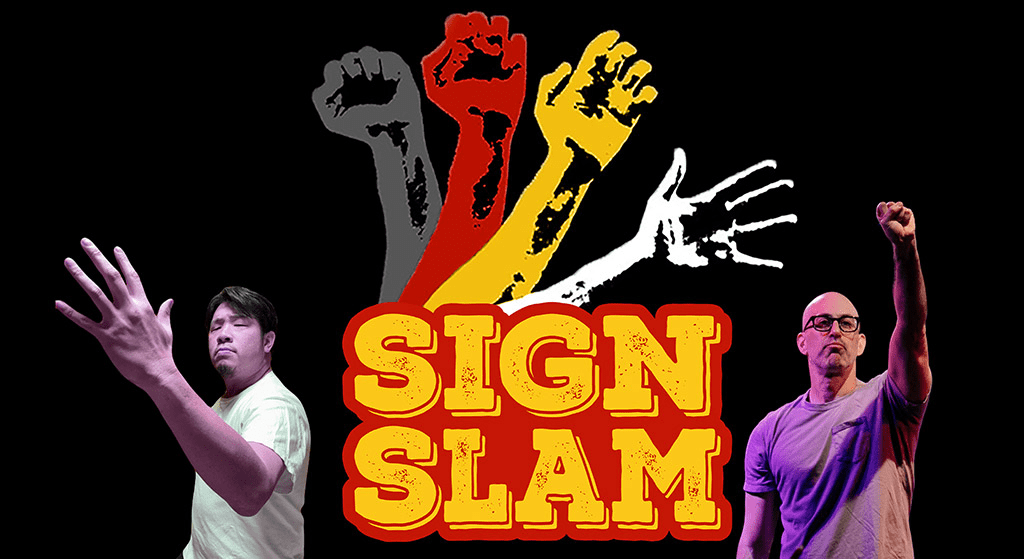
Image Description: A bold poster shows the words SIGN SLAM in big yellow letters, flanked by two performers striking strong hand poses, with stylised raised fists and hands in grey, red, yellow and white behind them on a black background.
Another big part of my festival experience was SIGN SLAM. TIDAF hosted SIGN SLAM Qualifiers and Finals, presented as an international sign language battle that tested improvisation and expressive power.
I entered the SIGN SLAM Qualifiers. I did not make it to the Finals, but I am pleased that I stepped onto that stage. Performing in front of an international Deaf audience already felt like an important step in growing as an artist in my local scene.
Watching the other participants was like having a live masterclass. Some pieces were deeply personal others wildly playful. I learnt so much about story structure, pacing and the use of Deaf artistry simply by observing how different participants shaped their stories.
Deepening my thinking: Panels and Talks
Between shows and workshops, I attended panel discussions that really enriched my understanding.
One important session was “Sign Language Coach/Supervisor and Director of Artistic Sign Language (DASL): Insights from the Field”, featuring Douglas Ridloff, Mayumi Ishimura, Mika Imai, Satoshi Ezoe and Kentaro Hayase.
The panelists talked about the role and scope of Sign Language Supervisors, ASL coaches, and DASLs in film and stage, explaining how their work combines language coaching and cultural consultation to keep sign languages accurate, natural and cultural grounded.
Mayumi, Mika, Satoshi and Kentaro are Deaf actors-consultants based in Japan. They often appear in performances, films and TV productions that highlight Deaf culture, for example, Gojyubi (Finger Kanaji), Oh Girl, It Hurts, Rite of Identity, Inori, Idle Hands and The Silenced.
Douglas has worked as an ASL coach-consultant for several major film and TV productions, such as A Quiet Place (2018), A Quiet Place Part II (2020), Eternals (2021), Godzilla x Kong: The New Empire (2024), Hawkeye (TV mini-series, 2021), Only Murders in the Building (TV series, 2021-2022) and Echo (TV mini-series, 2023-2024). His role involves working closely with directors and actors, teaching them ASL, and helping to ensure that ASL is portrayed authentically and integrated well into the story.
Listening to these practitioners compare experiences from Japan and USA helped me see how vital Deaf-led language supervision is in mainstream productions.
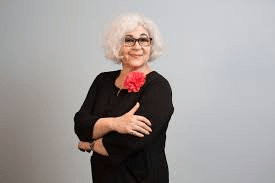
Image Description: Mira Zuckermann, Teater Manu (Norway)
An older woman with short curly white hair and glasses stands against a plain light background, wearing a black top with a bright pink flower pinned at the shoulder, smiling gently with her arms folded.
Another key moment for me was learning more about Mira Zukermann and the journey of Teater Manu, the Norwegian Deaf theatre she helped build into an internationally recognised institution supported by the government. Her long-term work in Deaf theatre leadership made me think deeply about what it takes to create sustainable Deaf-led companies in our own region.
Artists who inspired me: Teater5005 and Mira Zuckermann
Throughout the festival, I kept coming back to two big inspirations: Teater5005 and Mira Zuckermann.
Teater5005’s work on “On the Edge” and their public sharing about their philosophy showed a clear commitment to centering sign language and Deaf culture while still speaking to mixed audiences. Their approach gave me concrete ideas about how to design collaborations that are truly Deaf-led, but open and welcoming.
Mira Zuckermann’s story with Teater Manu showed what can happen when a Deaf theatre insists on artistic excellence and long-term structure. Over many years, Teater Manu has grown into a professional Deaf theatre that collaborates internationally and tours widely.
As a person working in Deaf arts and music, I left TIDAF thinking more about strategy: How do we build similar spaces in Singapore and, maybe Southeast Asia? How do we nurture Deaf leadership and Deaf youth so that these spaces are not just one-off projects but lasting institutions?
Living in a “City of Sign Language”
And a Royal Surprise in JSL
The overall festival design made the theme “City of Sign Language” feel very real. TIDAF focuses on connecting the world through Deaf arts and culture, with sign languages and visual expression at the centre of everything: theatre, film, immersive works, fringe activities, and more, all spread around Koenji.
For a few days, Deaf ways of communicating felt like the default. Hearing people are the ones entering our space rather than the other way around. That feeling of being centred as a Deaf person is rare and precious.
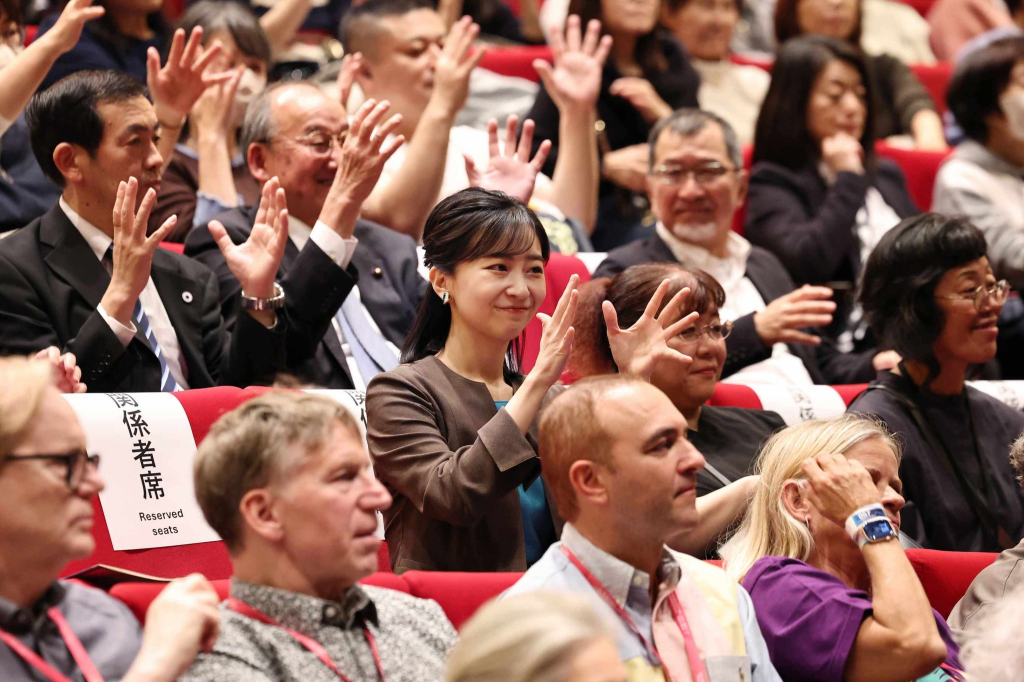
Image Description: In the centre of the audience, a young woman in a dark jacket and blue top smiles as she raises both hands in Deaf applause, fingers spread, surrounded by others doing the same in a packed theatre.
In the middle of all this, there was one extra special moment for me: knowing that Princess Kako of Japan attended the opening ceremony of the festival at ZA-KOENJI. On 6 November 2025, Thursday, she was there, watching performances by Deaf artists and interacting with participants using Japanese Sign Language (JSL).
Princess Kako has been working part time with the Japanese Federation of the Deaf (JFD), and uses JSL regularly in her official activities, often giving speeches and interacting with Deaf communities.
I only caught a brief glimpse of her in person, but it still meant a lot. Seeing a member of the Imperial Family present at a Deaf-led arts festival, using JSL with respect, felt like a powerful recognition of our languages and culture. It reinforced the feeling that TIDAF really was a city of sign language, from community spaces all the way up to national visibility.
Reflections on Singapore
Coming home, I cannot help comparing this “City of Sign Language” with the current situation in Singapore. In our local arts scene, we still have very few Deaf artists working in the performing arts, not only in theatre but across other forms too. The Hi! Theatre closed many years ago, and I feel that this loss has affected our Deaf culture and reduced our visibility on stage.
Many Deaf Singaporeans do not yet have the habit of attending mainstream arts events, and Deaf presence in those spaces is still limited. We do have some Deaf artists in illustration, crafts, and photography. I rarely see Deaf poetry in Singapore, especially in sign language arts.
Experiencing TIDAF has strengthened my desire to push for Deaf arts at home, including Visual Vernacular and sign poetry. I want more Deaf people in Singapore to see Deaf-led performances, recognize our own creative power, and feel that our languages and stories belong on stage too.
What I am taking home
As I return home from Tokyo, I carry with me:
- New tools and ideas from the VV and Visual Sign Language Expression workshops
- Strong memories of theatre that trusts sign languages and visual storytelling
- Lessons from SIGN SLAM about sign improvisation on stage
- Inspiration from Teater5005 and Mira Zuckermann about building sustainable Deaf-led institutions
- The emotional memory of living, even briefly, in a “City of Sign Language” where sign languages are celebrated, not just accommodated
- A little story to tell about the day I glimpsed Princess Kako signing at a Deaf arts festival
TIDAF 2025 has challenged to think bigger about Deaf arts in my own context and to keep pushing for spaces where sign languages and Deaf creativity are not only included, but placed right at the heart of the work.
If you are creating or supporting Deaf-led arts in Singapore, I hope this glimpse into my experience at the Tokyo International Deaf Arts Festival 2025 encourages you to imagine your own version of a “city of sign languages” wherever you are.

 Lily Goh
Leave a comment